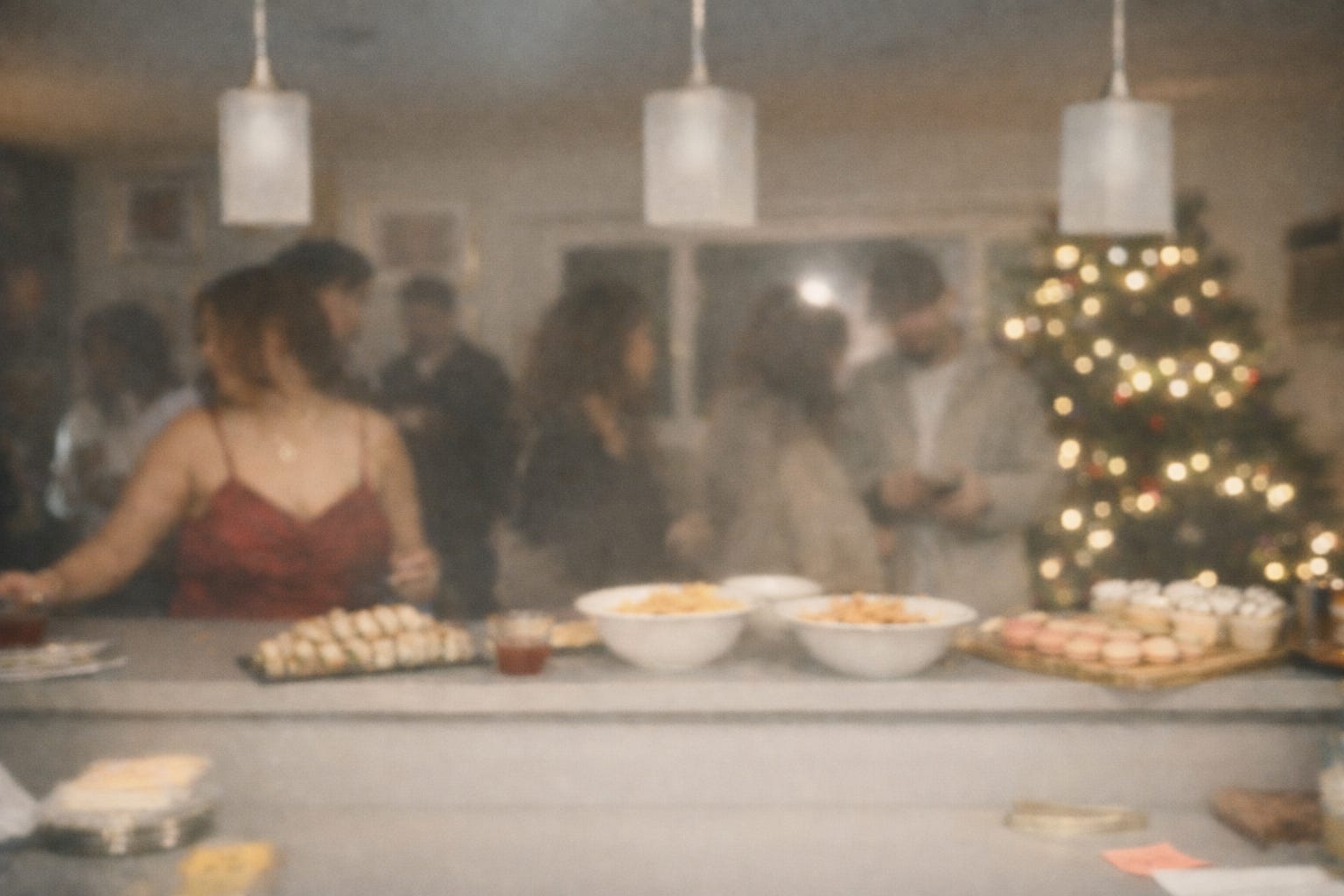
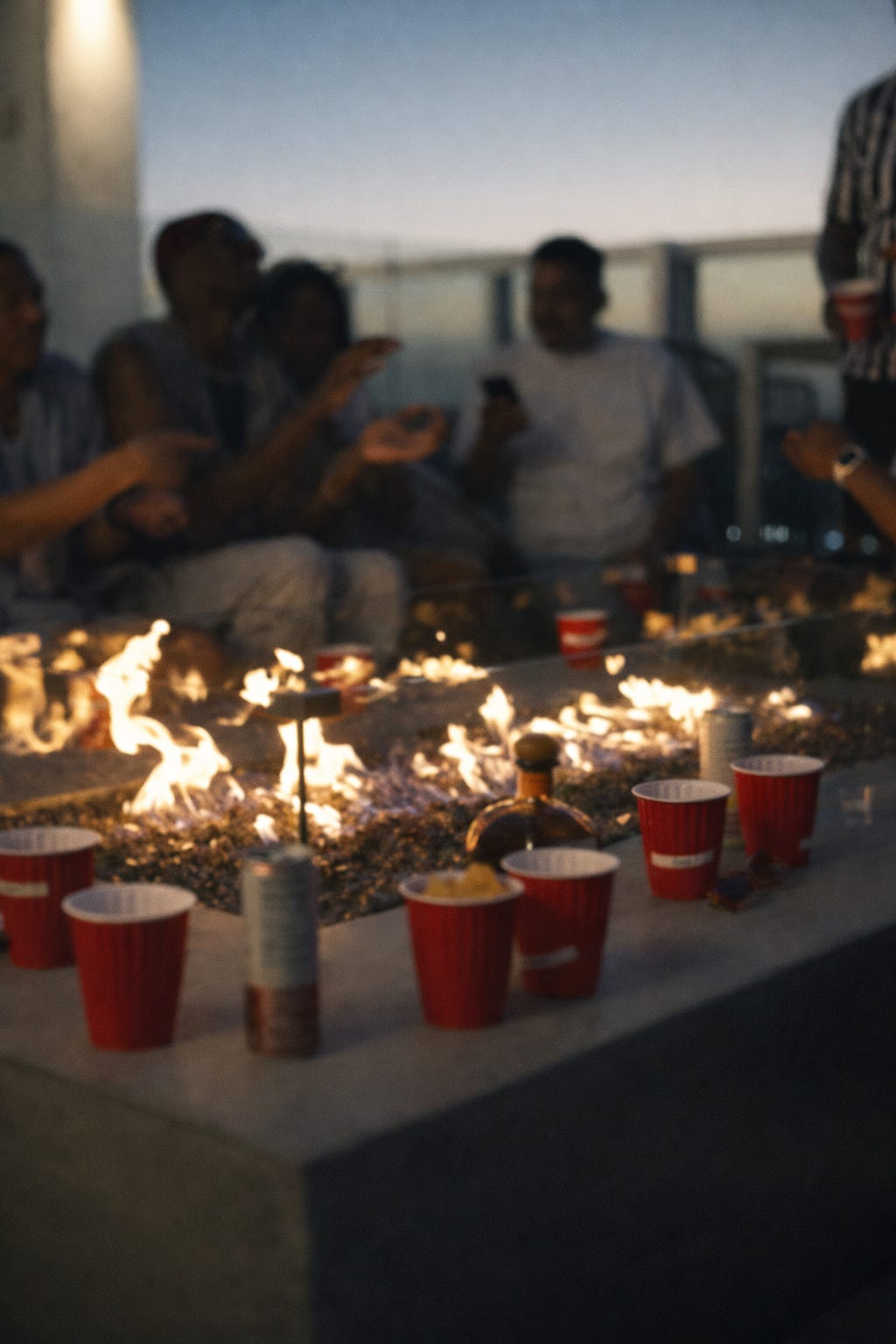
Some happen quietly in rooms already full, in conversations already underway, in moments where no one asks you to introduce yourself.
This issue sits with what happens after the entrance. After the door closes behind you. After the room looks up. After you realize you are visible without having volunteered to be.
Issue No. 02 explores social presence without performance, connection without immediacy, and the unfamiliar work of letting yourself be seen without offering yourself up.
This is not a guide on how to enter rooms. It is an examination of what it means to stay.
The Pause After Arrival
There is a particular moment that happens in social spaces, the pause after arrival.
Not the entrance. Not the greeting. But the moment after, when the room continues without acknowledging the shift.
Conversations remain mid-thought. Laughter carries on. The energy does not reorganize itself for the newcomer.
And yet, something changes.
A new presence must be oriented.
In a culture that prizes immediacy, instant connection, instant familiarity and instant likability, this moment can feel unusually exposed.
There is no introduction to anchor you. No role assigned. No script to follow.
The room does not explain itself. And it does not ask you to explain yourself either.
But the impulse, learned early, is to do so anyway. To smile wider, to speak sooner and to soften edges.
“We are trained to make ourselves understandable.”
Arrival, in its truest form, asks for the opposite.
To resist filling silence. To resist narrating your presence. To resist shrinking or expanding to fit the room prematurely.
Instead, arrival asks for tolerance and for the discomfort of being unplaced.
Confidence Without Command
In today’s culture, unplaced is often mistaken for unconfident. Quiet is confused with uncertainty. Reserve is read as distance.
But there is a difference between absence and restraint.
Visibility without invitation can feel confrontational, not because it is hostile but because it removes permission structures.
There is no applause. No validation cue. No immediate signal that you are “doing it right.”
In a world shaped by algorithms, metrics, and social proof, this lack of feedback can feel disorienting.
Pop culture tells us that confidence looks like command: the woman who owns the room, who dominates the conversation and who is instantly adored.
But another lineage exists.
The woman who arrives slowly. Who observes before engaging. Who allows curiosity to form around her instead of offering herself up.
“Not all presence announces itself.”
Some presence settles. Some presence waits. Some presence refuses to compete for attention.
This is not passivity, this is discernment. The body acclimating. The nervous system gauging safety of the self while it’s deciding—not if it belongs, but how much it wishes to give.
Arrival, today, is not about being immediately understood.
It is about remaining intact long enough for understanding to arrive later.
It is the confidence of staying present without performance. Of allowing others to orient themselves to you and trusting that what is meant to connect will do so without force.
“Confidence is quiet.”
Arrival is quieter still.
Presence Without Consumption is the work of arrival in a hyper-visible world:
to be seen without becoming consumable, to be noticed without being reduced, to exist in a room without translating yourself into palatability.
Not announcing who you are. Not explaining why you belong.
But allowing who you are to register— slowly, honestly and without urgency.
There is beauty in spaces where people already belong. And there is grace in knowing you don’t have to rush your place among them. .
Spotted. Seen. Heard
From the Studio
This issue continues the practice of space. Fewer images. More breathing room. Less explanation.
The Balcony is not a place to be understood quickly. It is a place to return to.
Issue No. 02 is designed to be read slowly, revisited later, or left open on the table.
If this found you at the right moment, there’s more from the balcony.
The Second Look
Some people call it shyness. Others call it reserve. But often, it is simply acclimation.
The body takes time to settle into new environments. The mind surveys exits and rhythms. The nervous system listens before it speaks.
In a culture that rewards immediacy, acclimation can be mistaken for absence. But there is nothing absent about someone who is paying attention.
Not every woman is meant to enter loudly. Some are meant to arrive slowly.
And there is nothing incomplete about that.
Not everyone who is quiet is unsure. Some are simply deciding where to stand.
This is not withdrawal. This is discernment.
The Calendar
Sunday Dinner Club
An intimate, design-forward gathering created to bring thoughtful people to the same table and to document what unfolds when they do.
This is not networking. This is not a panel. This is not performative connection.
It is a beautifully composed evening. A styled table, a curated menu and a guest list selected with intention. Creating conversation that lingers long after the plates are cleared.
Hosted by our studio, Sunday Dinner Club gathers women and aligned creative community for an elevated dining experience centered on good food, good vibes and presence, while thoughtfully capturing the atmosphere for our publication.
Guests are not treated as subjects, but as contributors to culture — the energy, perspective, and presence in the room are what shape the story.
Come solo or with a friend. Many arrive alone and leave having expanded their circle.
Seating is intentionally limited.
If this feels like your kind of room, consider this your invitation.